
You’re probably dealing with one of two jobs right now. You’re either trying to plan an event that feels warm, stylish and emotionally switched-on, or you’re looking at a record shelf and wondering which mtv unplugged albums are worth owning rather than merely famous. In both cases, the same question comes up. What made those sessions last when so much other 90s music television now feels trapped in its era?
The short answer is restraint.
MTV Unplugged worked because it took artists who were used to volume, spectacle and expectation, then removed the safety net. What was left was songcraft, arrangement, room feel and human presence. For DJs, collectors and event planners in the UK, that still matters. These records aren’t just nostalgia objects. They’re practical tools for building atmosphere, pacing a room and choosing music that people feel rather than merely recognise.
The Enduring Power of MTV Unplugged
A lot of event briefs ask for the same three things in different language. Couples want romance without corniness. Brands want sophistication without stiffness. Private clients want nostalgia without turning the night into a costume party. That combination is exactly where the mtv unplugged legacy still earns its keep.

The acoustic format gives familiar songs a different job to do. A loud original might energise a room, but an unplugged version often creates attention, closeness and memory. That matters early in an evening, during dinner, through a drinks reception, or in the stretch just before a dance floor properly opens.
Recent UK behaviour shows this isn’t a niche taste. An Eventbrite UK report noted that listings for “unplugged weddings” and acoustic house parties in London and Kent surged 32% year over year, with over 4,200 events in the last 12 months using tags like “MTV Unplugged vibes” or “acoustic 90s vinyl”, as reported in this Louder feature on how MTV Unplugged redefined a generation of rock.
Why the format still lands
People don’t respond to unplugged music only because it’s acoustic. They respond because it feels exposed. Small arrangement choices become audible. Breathing, phrasing and silence start doing more work. At events, that creates a social effect. Guests lean in. They talk differently. They stay present instead of treating the music as wallpaper.
That’s why the best unplugged-inspired programming works in these settings:
- Ceremony and reception transitions where the room needs elegance rather than impact
- Corporate dinners where conversation matters as much as soundtrack
- Private parties that need recognisable music without the hard edge of club volume
Practical rule: If a room needs connection before it needs momentum, an unplugged-informed playlist will usually outperform a straight run of original radio versions.
What works and what doesn’t
What works is using the unplugged idea as a design principle. Keep the emotional clarity. Keep the recognisable songwriting. Keep the sense of intimacy.
What doesn’t work is assuming acoustic always means low energy. It doesn’t. A smart selector uses these tracks to create contour. They can soften a room, reset a room, or prepare a room for a stronger lift later in the night.
That’s the lasting lesson. mtv unplugged wasn’t just a television format. It became a blueprint for how to make music feel personal in a shared space.
How MTV Unplugged Changed Music Television
When mtv unplugged launched in 1989, it changed the grammar of music television. At the time, pop and rock performance on screen often leaned on scale. Big lighting. Big amplification. Big visual attitude. Unplugged turned the lens the other way and asked a harder question. What happens when the song has to stand on its own?
The core idea was simple
Put artists in a smaller setting. Strip back the arrangement. Let the audience hear wood, wire, breath and phrasing instead of being pushed along by production excess. That sounds obvious now, but it wasn’t obvious then.
The format mattered because it challenged two assumptions at once:
- That television needed spectacle to hold attention
- That major artists needed electric force to feel important
Unplugged proved both assumptions wrong. A stool, a microphone and a rearranged catalogue often revealed more about an artist than a full arena setup.
Why it felt different on screen
The visual language helped. The set design usually felt closer to a listening room than a television studio. The audience looked engaged rather than dazzled. The artist often had to explain song choices, rethink tempos, or rebuild well-known tracks from the ground up.
That created a different kind of authority. Viewers weren’t just watching a performance. They were watching an artist take a risk in real time.
The moment an artist removes volume, every weak arrangement choice becomes obvious. That’s why the best Unplugged sets still sound disciplined rather than casual.
The lasting shift in expectations
Music television didn’t stop being glossy because of mtv unplugged, but audiences began expecting another option. They learned to value reinterpretation. They learned that vulnerability could carry as much weight as power. Artists learned something too. If an unplugged performance failed, the problem usually wasn’t the format. It was the song, the arrangement, or the confidence behind it.
For working DJs and planners, that history still has practical value. It reminds you to judge music by function, not just fame. A huge hit in its original form can be too aggressive, too busy or too self-important for a particular room. An acoustic reworking can solve that.
A useful planning lens
When assessing whether an unplugged-era track belongs in an event set, ask three questions:
- Does the lyric become clearer? If yes, it can work well in attentive moments.
- Does the groove survive the stripped arrangement? If yes, it can bridge into more rhythmic material later.
- Does the vocal feel human rather than polished flat? If yes, guests usually trust it faster.
That’s the television revolution the series left behind. It taught audiences to listen for substance. Once that happened, the show became bigger than its own format.
The Performances That Defined a Generation
Some mtv unplugged sessions are remembered because they were famous artists doing something unexpected. A smaller group endure because they changed how people heard the artist afterwards. In the UK, Eric Clapton’s session belongs firmly in that second category.

Clapton’s 1992 MTV Unplugged session became a cornerstone for UK listeners. The album then topped the UK Albums Chart for three weeks and reached 10x Platinum with over 3 million copies sold in the UK, making it one of the best-selling live albums in British history, according to the MTV Unplugged reference entry.
Why Clapton’s session mattered in Britain
Plenty of live albums sell well. Fewer reset an artist’s public image. Clapton’s unplugged set did that by making his catalogue feel less remote and more conversational. The blues phrasing came forward. The room sound helped. The arrangements didn’t feel like stripped-down versions of electric performances. They felt rebuilt for listening.
That distinction matters. Some acoustic sessions sound like compromises. Clapton’s sounded intentional.
For UK audiences, that was important in the early 90s because the material connected with both long-time rock listeners and buyers who wanted something mature and replayable at home. The session also fed directly into collecting culture. A record that works in the room and works on the turntable tends to last.
More than one genre benefited
The format’s real strength was range. It wasn’t reserved for heritage rock acts. Artists from pop, soul, alternative and hip-hop could all use it to reveal different strengths.
A useful way to think about the most memorable sessions is this:
| Artist type | What Unplugged exposed | Why it lasted |
|---|---|---|
| Established rock artist | Songwriting and phrasing | It replaced bombast with craft |
| Pop vocalist | Control and interpretation | It cut through overproduction |
| Alternative act | Texture and tension | It made mood feel immediate |
| Genre crossover artist | Flexibility | It proved the songs travelled |
That’s why people still talk about the series as a cultural marker rather than a one-format novelty. It gave artists a second frame. Sometimes that frame became the definitive one.
The performances that still teach DJs something
For a DJ, the most useful unplugged sessions aren’t always the ones with the biggest reputation. They’re the ones that show how a familiar song behaves when its armour is removed. That can tell you whether the track has enough melodic and lyrical spine to survive a quieter placement in a set.
A strong unplugged performance often gives you three programmable advantages:
- Recognition without harshness
- Emotion without sentimentality
- Tempo control without losing audience trust
Later in the evening, that can be invaluable. You can cool a room down without flattening it.
A good example of the performance atmosphere that made the format so influential is worth revisiting here:
The best Unplugged sets didn’t just sound different. They changed what listeners thought the artist was capable of.
That’s why these sessions defined a generation. They weren’t side projects. They became main texts in the history of how popular music could be presented, bought and remembered.
Building Your Unplugged Album Collection
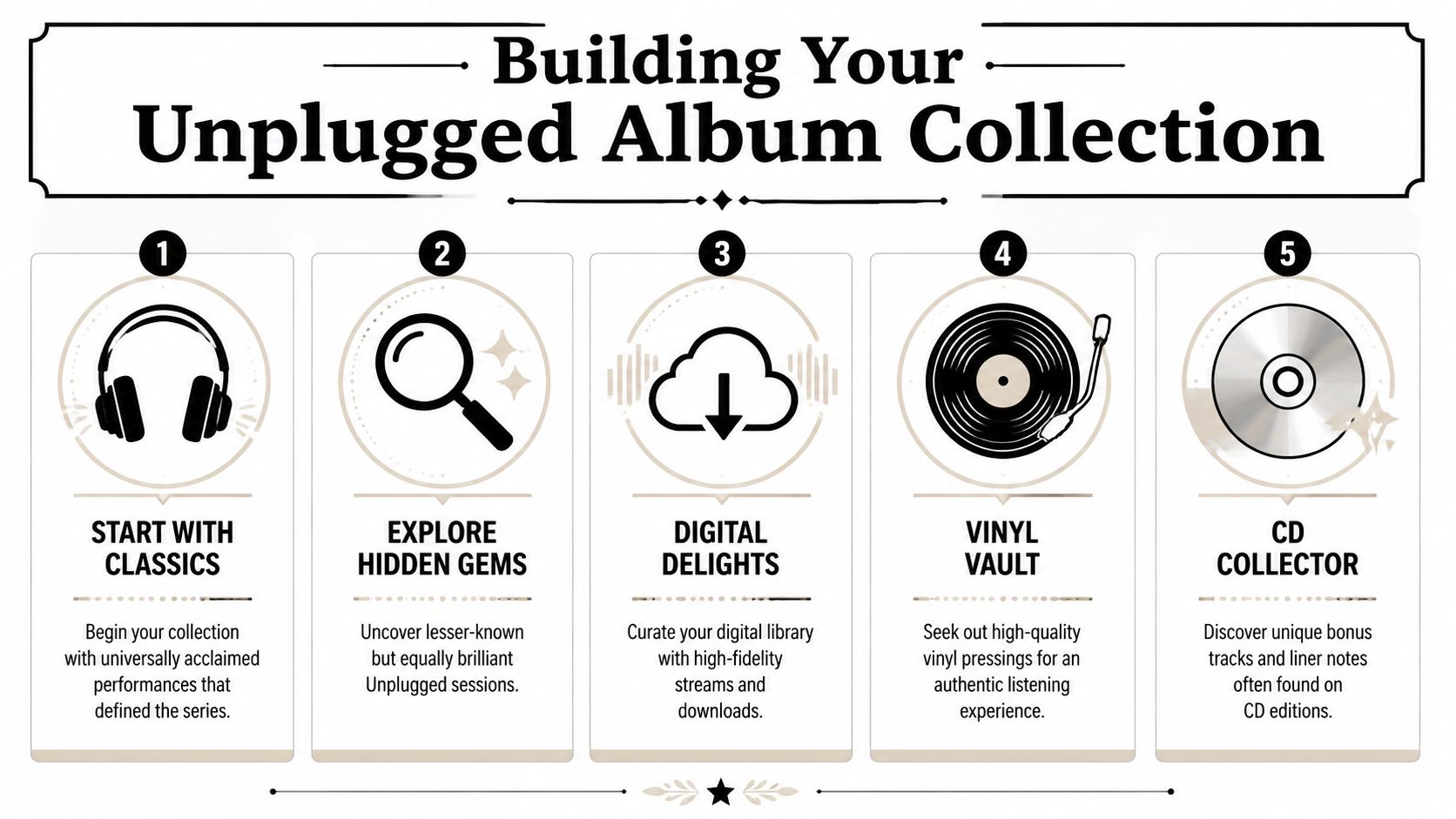
Collectors often make the same mistake first. They chase the famous title before they’ve decided what they want from an mtv unplugged shelf. Do you want records that demonstrate the format at its strongest? Pressings that reward close listening? Event-friendly albums you’ll reach for in real working situations? The answer changes what you buy first.
Start with records that explain the format
A useful unplugged collection should show variety, not just prestige. You want at least one title that demonstrates blues-rooted acoustic warmth, one that captures alternative tension, and one that sits comfortably in social listening contexts.
Here’s a practical starter table.
| Artist | Album Title | Year | VinylGold Notes |
|---|---|---|---|
| Eric Clapton | Unplugged | 1992 | The benchmark for warmth, phrasing and room feel. Excellent for home listening and early-evening event programming. |
| Nirvana | MTV Unplugged in New York | 1994 | Darker, more intimate and less crowd-pleasing in an obvious way. Essential if you want emotional weight and strong sequencing lessons. |
| Tony Bennett | MTV Unplugged | 1994 | Useful for collectors who want classic vocal presentation and a more lounge-facing social atmosphere. |
| Oasis | MTV Unplugged | 1996 | Valuable as a UK-reference set for Britpop listeners and for acoustic nostalgia programming. |
For anyone curating a visual mood board alongside the music, this personal events and legendary music visual captures the sort of atmosphere many clients are trying to describe when they talk about “timeless” music.
Why some unplugged records sound better than others
The sonic appeal of these albums isn’t accidental. Clapton’s album is the clearest example. Its sound came from a Martin 000-28EC guitar, Neumann KM184 microphones and Neve 1073 preamps. Technical reviews say that chain reduced harmonic distortion and produced a 40% increase in midrange clarity, which helps explain why those pressings sound so warm and present on a good system, as outlined in Martin Guitar’s piece on 30 years of Unplugged inspiration.
That detail matters for collectors because unplugged records live or die in the midrange. If vocals sit naturally and the acoustic guitar has body without mud, the record keeps its intimacy. If the pressing is flat or brittle, the entire point of the format is weakened.
A better buying method
Don’t buy only by artist reputation. Buy by listening goal.
- For room warmth choose titles with natural vocal presence and audible air around the instruments.
- For serious listening prioritise editions known for clarity, quiet surfaces and balanced acoustic tone.
- For event use choose records whose arrangements are familiar enough to welcome guests in, but soft-edged enough not to dominate conversation.
Collector’s note: A great unplugged album should still reward you at low volume. If it only comes alive when pushed, something in the pressing or mastering is probably fighting the format.
CD editions can also be worth owning for liner notes and alternate context, while digital copies are useful for prep and reference listening. The format matters less than the purpose. Good collections are built around use, not just accumulation.
Sourcing Rare Pressings and Programming Sets
A professional DJ doesn’t collect unplugged records only for display value. These records solve real programming problems. They help open a room without making it feel sleepy. They help reset after a peak moment. They help bridge generations because even younger guests often recognise the emotional language, whether or not they know the broadcast history.

Why Nirvana pressings stay in demand
Nirvana’s Unplugged in New York is a perfect case study because it sits at the intersection of collecting and event memory. The broadcast drew 5.1 million UK viewers, the highest for a music special that year. The album then debuted at No.1 in the UK and reached 5x Platinum certification, which helps explain why original UK pressings remain so sought-after and why the tracks still carry strong cultural weight at events, as noted in this YouTube record of the performance’s UK significance.
That sort of demand shapes pricing, but it should also shape how you inspect copies. A desirable title attracts overgrading, tired sleeves and optimistic descriptions.
What to check before you buy
When you’re sourcing rarer unplugged vinyl through marketplaces or shops, condition discipline matters more than excitement. If you need a structured system for evaluating records and sleeves, Vorby’s guide to cataloging vinyl collections is useful because it helps standardise how you assess grading claims before money changes hands.
Focus on these checks:
- Sleeve integrity matters if the title has collector demand. Ringwear and seam splits can drag value down quickly.
- Surface inspection should happen under proper light. Acoustic records expose crackle and groove wear more brutally than dense electric mixes.
- Matrix and pressing details are worth confirming when the seller implies an early edition.
- Playback expectation should stay realistic. A visually nice copy can still disappoint if quiet passages reveal noise.
How to use unplugged tracks in a live set
The biggest mistake DJs make is dropping unplugged tracks as novelty moments. That rarely works. These records are strongest when they’re treated as pacing tools.
Use them in one of three ways:
-
Arrival and drinks reception
Familiar songs in acoustic form help guests settle in without feeling as if the night has already begun. -
Reset after a heavy run
If the floor has had a strong burst of disco, house or pop, one well-placed unplugged cut can bring focus back to the room. -
Late emotional turn
Near the end of a wedding or private party, a stripped-back version can deepen the memory of the last stretch without killing momentum.
A visual cue for this kind of record-led approach sits well with the old-school DJ identity many clients still respond to, as shown in this gold-toned Vinyl DJ insignia.

Don’t use unplugged tracks because they’re acoustic. Use them because they change the room’s breathing pattern.
That’s the professional argument for owning them. They aren’t side assets. They’re specialist records with real tactical value.
How Unplugged Inspires Modern Event Soundtracks
The most useful thing mtv unplugged left behind isn’t a playlist. It’s a philosophy of event sound. Strip away the branding and the candles and you’re left with four principles that still improve modern programming in London, Kent and beyond. Intimacy. Clarity. Restraint. Recognition.
Intimacy beats constant intensity
Many events fail musically because they aim for peak energy too early and stay there too long. Guests stop noticing individual tracks. The room gets flatter, not stronger. Unplugged thinking fixes that by valuing contrast.
An acoustic or stripped-back stretch can make the next rhythmic lift feel earned. That’s useful at weddings in particular, where the event has multiple emotional phases rather than one single nightclub arc.
Clarity helps guests connect faster
A lot of original studio hits are crowded. Layers compete. Effects date the production. The unplugged approach often reveals the line that people love, whether that’s the vocal phrase, the lyric or the chord movement.
For planners, that means a song choice can be both familiar and refined. For DJs, it means you can maintain recognisability without forcing the room into full-volume response.
A visual shorthand for this warmer booth-to-room relationship can be seen in this golden DJ booth mood image.
How to build an unplugged-informed event flow
This isn’t about playing acoustic versions all night. It’s about borrowing the logic.
| Event moment | Unplugged principle | Practical result |
|---|---|---|
| Guest arrival | Soft recognition | People settle without feeling underwhelmed |
| Dinner or mingling | Space and clarity | Conversation stays easy |
| Transition to dancing | Familiarity with lift | Guests move with less resistance |
| End-of-night stretch | Emotional directness | The close feels memorable rather than noisy |
What usually works best
- Use acoustic versions as bridges, not isolated gimmicks.
- Choose songs with strong writing first. Weak songs don’t improve because they’re unplugged.
- Keep arrangements in context. A raw Nirvana track and a polished soul ballad ask different things of a room.
- Trust quieter moments. Guests often remember the emotional pivot points more than the loudest ten minutes.
What usually fails is overcommitting to the concept. A whole event built on one texture can become samey, even if the music is good. The better approach is selective use. Bring in the unplugged sensibility where it sharpens attention, softens transitions or gives a familiar lyric extra impact.
A modern event soundtrack works best when every rise in energy has a reason, and every quieter passage still feels intentional.
That’s why mtv unplugged still matters. It taught the industry that less arrangement can create more connection. For collectors, that means these albums deserve proper shelf space. For DJs, they deserve proper set space. For planners, they offer a tested way to make an event feel human.
If you want a soundtrack that balances nostalgia, elegance and proper dance floor judgement, VinylGold builds bespoke music for weddings, private parties and corporate events across London and Kent. The focus is simple. Better programming, better flow and music that fits the room rather than fights it.