Put simply, high-resolution audio is any sound file that offers better quality than a standard CD. It’s designed to capture more of the original studio recording’s detail, depth, and nuance, giving you a listening experience that’s much closer to what the artist and producer actually heard.
What Is High-Resolution Audio?
The best way to think about audio quality is to compare it to a digital photograph. A standard MP3 file is like a compressed JPEG image—it’s small and convenient, but you lose fine details, and colours can look a bit washed out. It gets the job done, but it’s a compromised version of the original.
High-resolution audio, on the other hand, is like the original RAW photo file you’d get straight from a professional’s camera. It contains all the original data, capturing every subtle shade, texture, and detail with stunning clarity. Ultimately, it means you hear more of the music.
Why Quality Matters Beyond the Numbers
This difference isn’t just some abstract concept for audiophiles with ridiculously expensive setups. It has a real-world impact on how we connect with music. We see this pursuit of clarity everywhere—take tools like AI image upscalers, which are built to restore lost visual detail. High-resolution audio does the same thing for sound, preserving the music’s integrity.
All that extra detail translates into a richer, more immersive soundscape. Here’s where it makes a genuine difference:
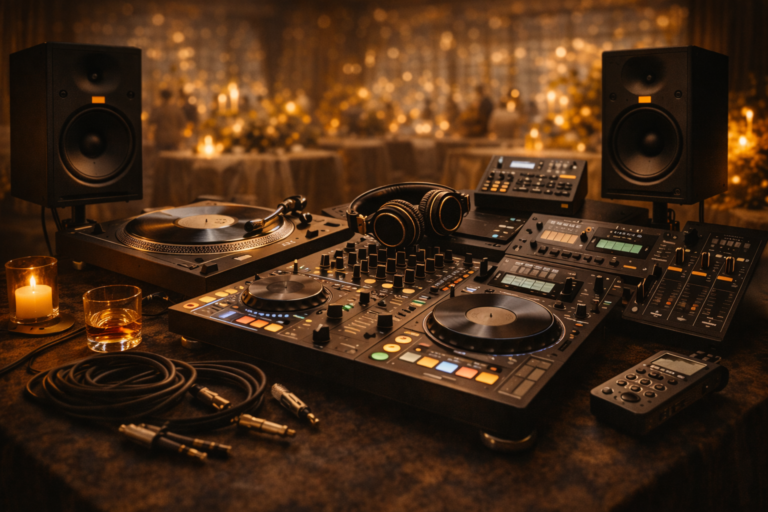
- For DJs and Events: When a professional DJ is putting together a set for a wedding or a corporate party, high-res audio delivers a cleaner, more powerful sound. The bass has more punch, the highs are crisper, and all the intricate layers in a track are distinct, creating a tangible energy that gets people on the dance floor.
- For Music Lovers: If you truly love music, it’s about hearing your favourite songs in their full glory. You start to notice things you’ve never heard before—the subtle sound of a guitarist’s fingers sliding on the strings, the delicate decay of a cymbal, or the faint echo in a vocalist’s breath. These are the details often lost in compressed files.
High-resolution audio isn’t really about being an ‘audiophile’; it’s about reclaiming the detail and emotion that get stripped away by compression. It’s for anyone who wants to connect more deeply with the music they love.
At the end of the day, better sound quality just makes for a better experience, whether you’re celebrating a milestone or just kicking back with a classic album. You can check out more of our guides for tips on building the perfect soundscape for any occasion. https://vinylgold.co.uk/wp-content/uploads/2026/01/vinyl-gold-logo-golden-600×342.avif
Understanding Bit Depth and Sample Rate
To really get what makes high-res audio special, we need to look under the bonnet at its two core ingredients: bit depth and sample rate. They might sound a bit technical, but they’re the keys to unlocking more detail and life from your music. Let’s break them down.
Sample Rate: A Digital Flipbook for Sound
Think of it like this. If you’re trying to capture the arc of a thrown ball but only take two photos—one at the start and one at the end—you miss all the movement in between. But if you take dozens of snapshots every second, you can play them back to create a smooth, fluid animation.
Sample rate is the audio version of this. It’s a measure of how many “snapshots” or samples of a soundwave are taken every single second.
- A standard CD takes 44,100 snapshots per second (or 44.1 kHz).
- High-res audio, however, captures far more information, with sample rates of 96 kHz or even 192 kHz.
This higher sampling frequency allows for a much more accurate picture of the original analogue soundwave. It’s the difference between a jerky animation and silky-smooth, high-frame-rate video. All the tiny details, the complex harmonics of an instrument, and the subtle atmosphere of the recording studio are captured with greater realism.
Bit Depth: The Musician’s Colour Palette
Now for bit depth. Imagine a painter working with just a handful of primary colours. They can still create a picture, but the shading will look rough and the transitions between colours will be blocky and unnatural.
Give that same painter millions of shades to work with, and they can create incredible depth, subtle gradients, and a far more vibrant, lifelike image. Bit depth is the audio equivalent of that expanded colour palette. It defines the number of possible loudness values for each snapshot we took.
In short, bit depth determines the dynamic range of a recording—the difference between the quietest whisper and the loudest, most explosive crescendo. More bits mean more room for the music to breathe.
A standard CD uses a 16-bit depth, which gives you 65,536 distinct volume levels. That’s pretty good, but high-resolution audio files use a 24-bit depth, offering an incredible 16,777,216 different levels of volume.
This huge leap in dynamic range means quiet passages don’t get lost in a sea of digital noise, and loud sections can hit with more impact without sounding crushed or strained. It’s this powerful combination of higher sample rates and greater bit depth that lets high-res audio deliver a sound that’s richer, more detailed, and far closer to what the artist heard in the studio.
A Practical Guide to High-Res Audio Formats
Choosing the right file format can feel like wading through an alphabet soup of acronyms, but it’s simpler than it sounds. Think of it as picking the right container for your music, one that fits what you plan to do with it. Once you get the main types of high-res audio formats, you’ll know exactly which one to pick every time.
The big difference comes down to uncompressed versus lossless compressed files.
- Uncompressed (WAV & AIFF): These are the raw, untouched audio files. Think of them as the original master painting—every single bit of information from the studio recording is present, making them the absolute highest quality.
- Lossless Compressed (FLAC & ALAC): These are more like perfectly packed digital zip files. They cleverly reduce the file size by up to 50% without throwing away a single piece of audio data. When you “unzip” or play the file, it is completely identical to the original uncompressed source.
This decision tree can help you visualise which path to take, whether you’re archiving a priceless collection or just want better-sounding music for your daily commute.
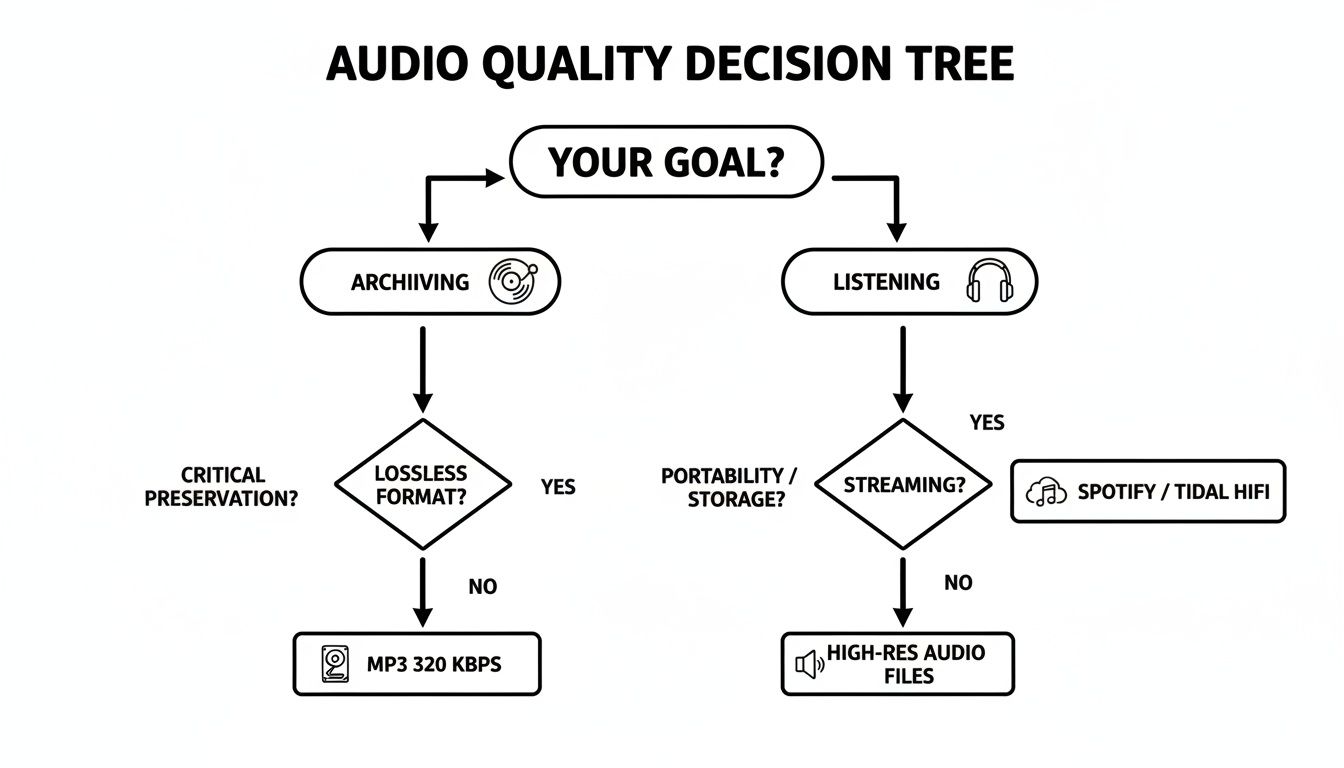
The key takeaway is that for pure preservation, uncompressed is king. But for everyday listening and saving precious hard drive space, lossless compression is the smart, practical choice.
Choosing the Right Format for You
So, which one should you actually use? It almost always boils down to what you’re using the music for and the gear you own.
For DJs and serious audio archivists digitising a precious vinyl collection, WAV or AIFF are the gold standard. Their uncompressed nature guarantees that zero data is ever lost, preserving every subtle detail for professional mixing or future generations. The larger file size is a small price to pay for pristine, archival-grade quality.
For almost everyone else, FLAC (Free Lossless Audio Codec) is the most versatile and widely supported choice. It’s open-source, which means it plays nicely on everything from Android phones and Windows PCs to most high-end digital audio players. It has become the go-to format for anyone wanting to build a high-quality digital library without completely filling up their hard drive.
If you live in the Apple world, then ALAC (Apple Lossless Audio Codec) is your best bet. It delivers the exact same quality as FLAC but is made to work seamlessly inside iTunes and across all your iOS devices. While FLAC has become more compatible with Apple gear over the years, ALAC is still the most painless, integrated choice for the ecosystem.
How to Listen to High-Res Audio
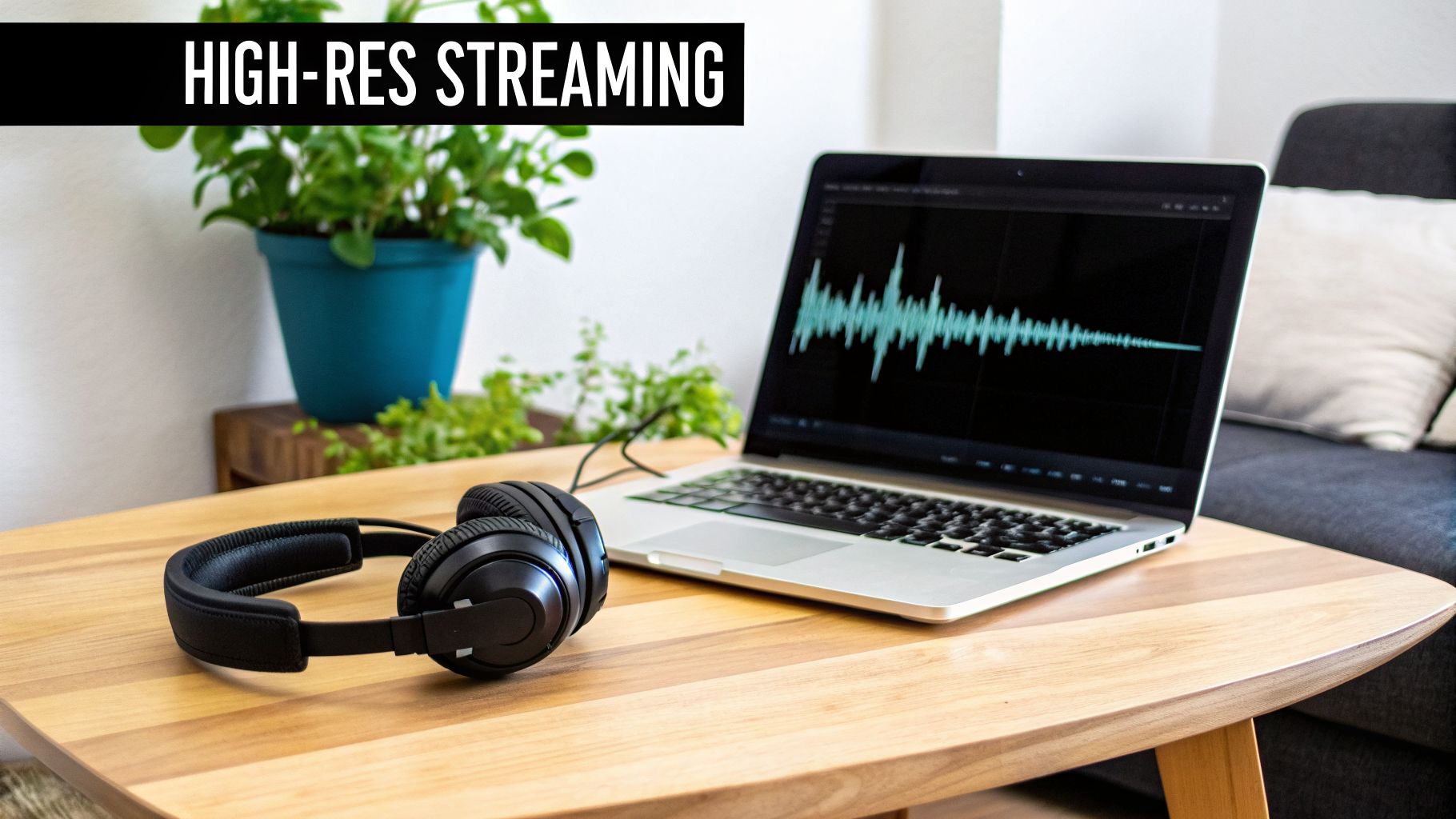
Alright, so you get the what and why. Now you’re ready to actually hear the difference for yourself. Getting into high-res audio is more straightforward than you might think, with a few clear paths depending on how you like to listen. It’s a bit like deciding how to watch a film—you can stream it on-demand, buy the Blu-ray for keeps, or play a copy you already own.
The three main ways to get your fix are through dedicated streaming services, buying from digital download shops, or ripping your own high-resolution files from physical media like vinyl. Each route strikes a different balance between convenience, quality, and ownership.
For most people, high-fidelity streaming is the easiest place to start. And the demand for better sound is definitely growing, especially here in the UK. Recent data shows that daily music and radio listening in the UK shot up to 2.6 hours in 2025. With a massive 77% of internet-connected adults using online music services, the appetite for quality is undeniable. The listening habits of today are a far cry from a decade ago.
High-Fidelity Streaming Services
If you’re after instant access to massive music libraries, several streaming platforms now specialise in high-resolution audio. Unlike the standard services that squash their files down with heavy compression, these platforms deliver music in at least CD-quality, often using lossless formats like FLAC.
Think of these services as your gateway to pristine sound, without the hassle of managing a huge library of large files on your hard drive. Here are the main players:
- TIDAL: Well-known for its “HiFi Plus” tier, TIDAL offers millions of tracks in FLAC, including a vast number of Master Quality Authenticated (MQA) files that deliver studio-grade sound. It’s a long-standing favourite among audiophiles and artists.
- Qobuz: This French service is built from the ground up for high-quality audio. Its entire catalogue comes in at least CD-quality (16-bit/44.1 kHz), with an enormous selection available in true high-resolution up to 24-bit/192 kHz.
- Apple Music: Apple shook things up by including its entire catalogue in lossless audio at no extra cost. This move made high-quality sound more accessible than ever for anyone inside their ecosystem.
- Amazon Music HD: Similar to Apple, Amazon rolled its “HD” (CD-quality) and “Ultra HD” (better-than-CD) tracks into its standard subscription, giving millions of people an instant quality upgrade.
Buying and Owning High-Res Music
For those of us who prefer to own our music—especially DJs building specific sets or collectors creating a permanent digital library—download stores are the way to go. These shops let you purchase and download high-resolution albums and individual tracks in formats like FLAC, WAV, and ALAC.
This approach gives you total control. Your music is yours, forever, free from the ties of a streaming subscription. It’s particularly great for sourcing classic soul, funk, and disco tracks that truly come alive with the extra detail and dynamic range of high-res audio.
Reputable stores like HDtracks, Bandcamp, and the Qobuz download store have extensive catalogues perfect for digging up timeless gems. When you own the high-quality files, you have the power to curate the perfect atmosphere for any event. You might find some inspiration in our guide on how to create legendary events with a personal feel.
The Essential Gear for Your High Res Setup
Having incredible high-res audio files is a great start, but it’s only half the story. The right gear is what actually delivers all that extra detail and richness to your ears.
Think of your setup like a chain—its strength is determined by the weakest link. The good news is that building a system worthy of high-res audio doesn’t have to be a complex or wildly expensive mission. The journey from a digital file to the sound you hear involves one incredibly important step, and that’s where we’ll start.
Understanding the Digital-to-Analogue Converter (DAC)
Every digital device you own, from your phone to your laptop, contains a built-in Digital-to-Analogue Converter, or DAC. Its job is straightforward but essential: it’s a translator. The DAC converts the ones and zeroes of a digital audio file into the smooth, analogue soundwave that headphones and speakers need to make music.
The problem is, the DACs included in most off-the-shelf devices are built for mass-market convenience, not for outstanding audio quality. They often become a bottleneck, holding back the full potential of a high-resolution track before it even has a chance to shine.
A dedicated, external DAC is the heart of any serious high-res setup. It bypasses the lower-quality chip in your device and performs the translation with far greater accuracy, preserving the subtle details, dynamics, and textures that make high-res audio so immersive.
This single piece of kit can make a more noticeable difference to your sound than almost any other component. It makes sure the signal coming from your source is as pure and faithful as possible before it gets anywhere near your ears.
Building Your High Res Setup
So, where do you start? Putting together your high-res audio chain can feel daunting, but it breaks down into a few key components. This table outlines the essentials, from what you absolutely need to what you can add as you get more serious.
| Component | What It Does | Good To Have | Must-Have |
|---|---|---|---|
| High-Res Audio Files | The source material (e.g., FLAC, WAV) with more data than a CD or MP3. | ✓ | |
| Playback Device | A computer, smartphone, or dedicated music player to store and play files. | ✓ | |
| External DAC | Converts the digital signal to analogue with high fidelity. | ✓ | |
| Quality Headphones | Delivers the sound directly to your ears for an intimate listening experience. | ✓ | |
| Quality Speakers | Fills a room with detailed sound for a shared listening experience. | ✓ | |
| High-Quality Cables | Ensures a clean signal path between your DAC, amplifier, and speakers/headphones. | ✓ | |
| Dedicated Amplifier | Powers passive speakers or high-end headphones for optimal performance. | ✓ |
Think of this as a checklist. You can start with the “Must-Have” items and build from there. Even just adding an external DAC to your existing computer and headphone setup can be a revelation.
The Final and Most Personal Link
Once your shiny new DAC has worked its magic, the analogue signal needs to become sound. This is where your headphones or speakers enter the picture, and your choice here is the final—and most personal—step in completing your high res audio setup.
A great pair of headphones offers the most direct and intimate connection to the music, creating a personal soundstage where every tiny detail is laid bare. If you prefer a shared experience, a quality set of speakers will fill your space with a rich, expansive sound. Either way, investing wisely here means you’ll actually get to hear the improvements your high-res files and DAC are capable of delivering.
This push for better sound isn’t just a niche hobby; it’s a growing movement. Here in the UK and across Europe, a strong audiophile culture is driving demand for premium audio in homes and even cars. This is part of a bigger picture: the global hi-fi system market, valued at USD 17.54 billion in 2026, is forecast to reach USD 22.28 billion by 2030, thanks to innovations in wireless and multi-room audio. If you’re curious, you can learn more about the high-resolution audio market trends and see how they’re shaping the future of listening.
Why High-Res Audio Is a Game Changer for DJs and Events
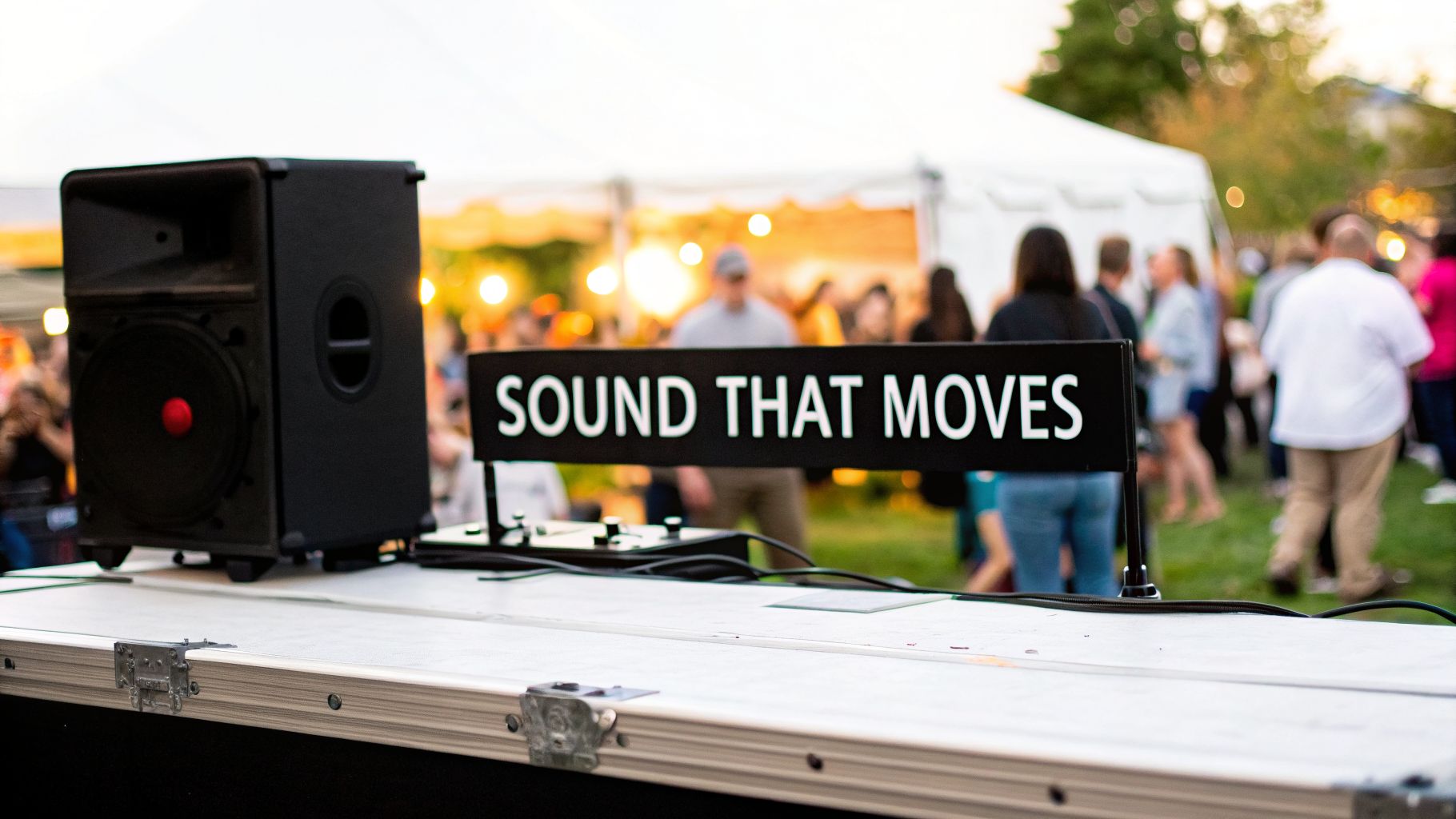
When you’re running a live event, brilliant sound quality isn’t just a nice extra—it’s the foundation of the entire atmosphere. For professionals, this is where high-res audio stops being a technical detail and becomes an essential tool of the trade. It’s what separates a good night from a truly unforgettable one.
For a DJ, the difference is night and day. It means cleaner mixes where individual instruments don’t blur into a sonic mess, letting you create silky-smooth transitions between tracks. That expanded dynamic range gives the bass a physical punch you feel in your chest, not just a muddy rumble you can hear.
Using high-resolution files gives a DJ far more sonic material to work with. It allows for more precise EQ adjustments and ensures the sound stays powerful and clear, even when pushed through a massive PA system. It’s the secret to creating an energy that keeps a dance floor packed all night.
This clarity and power completely transform the experience for every guest. At a wedding, it ensures every delicate note of the processional music is heard with crystal-clear definition. Later on, those classic dance floor anthems have the detail and energy to sound fresh and exciting, not flat and tired.
The Professional Edge in Sound
The impact of better sound goes way beyond the dance floor. Crystal-clear audio is vital for speeches, announcements, and even the background music that sets a mood without being intrusive. Using high-res audio signals a commitment to quality that clients and their guests can genuinely hear and appreciate.
This demand for quality is reflected across the industry. In the UK, the Audio & Video Equipment Retailers sector, which includes all the premium gear perfect for discerning DJs, reached a market size of £496.7 million in 2026. That sort of stability lets professionals invest in reliable, high-quality audio equipment that truly delivers.
Ultimately, investing in better sound is about creating moments that resonate. It’s about doing justice to the music and making sure every single beat contributes to an experience people will be talking about long after the lights come up. If you’re a DJ looking to elevate your setup, you might be interested in our guide on creating golden vibes in the DJ booth.
Your High-Res Audio Questions Answered
Stepping into the world of high-res audio naturally brings up a few practical questions. Let’s cut through the noise and get straight to what you need to know to start your journey with confidence.
Can You Really Hear the Difference?
Yes, absolutely. For most people, the difference is noticeable even on a half-decent audio setup. Think of it like watching a film in high-definition versus standard-definition. The story is the same, but the HD version suddenly reveals textures, colours, and background details you never realised were there.
High-resolution music works in a similar way. It delivers far greater depth, clarity, and dynamic range, making your favourite songs feel more alive and three-dimensional.
The difference is most obvious in the quietest and loudest parts of a song. With a high-res file, the softest whispers stay crisp and clear, while the loudest moments hit with more impact, free from that compressed, distorted edge. It just makes the music feel more dynamic and less ‘flat’.
Do I Need Expensive Gear to Start?
Not at all. While high-end, audiophile-grade equipment will certainly give you the ultimate experience, you don’t need to break the bank to hear a significant improvement.
A great place to begin is with a good pair of over-ear headphones and a basic external DAC (Digital-to-Analogue Converter). This combination alone will make a much bigger impact than you might expect, as it completely bypasses the low-quality audio components built into most laptops and phones.
What About Storage Space?
It’s true that high-res audio files are larger than their heavily compressed MP3 cousins, but with modern storage being so affordable, it’s a manageable trade-off. Thanks to clever lossless formats like FLAC, the file sizes aren’t nearly as huge as you might fear.
- An MP3 album might take up around 100 MB.
- A high-res audio album in FLAC format typically lands somewhere between 1-2 GB.
For the vast improvement in quality, that extra space is a small price to pay. It’s especially worth it if you’re archiving your most beloved albums or building a professional library for DJing.
Ready to elevate the sound at your next event? At VinylGold, we specialise in delivering unforgettable musical experiences with professional, high-quality audio setups. Find out more about our DJ services and let’s create the perfect soundtrack for your occasion.