

Inner sleeves for LPs are the most critical, yet most overlooked, accessory you can own. They are your record’s first line of defence against the dust, static, and scuffs that kill sound quality. Think of them less as an optional extra and more as the foundation of your entire collection’s health.
Why Inner Sleeves Are Your Vinyl’s First Line of Defence
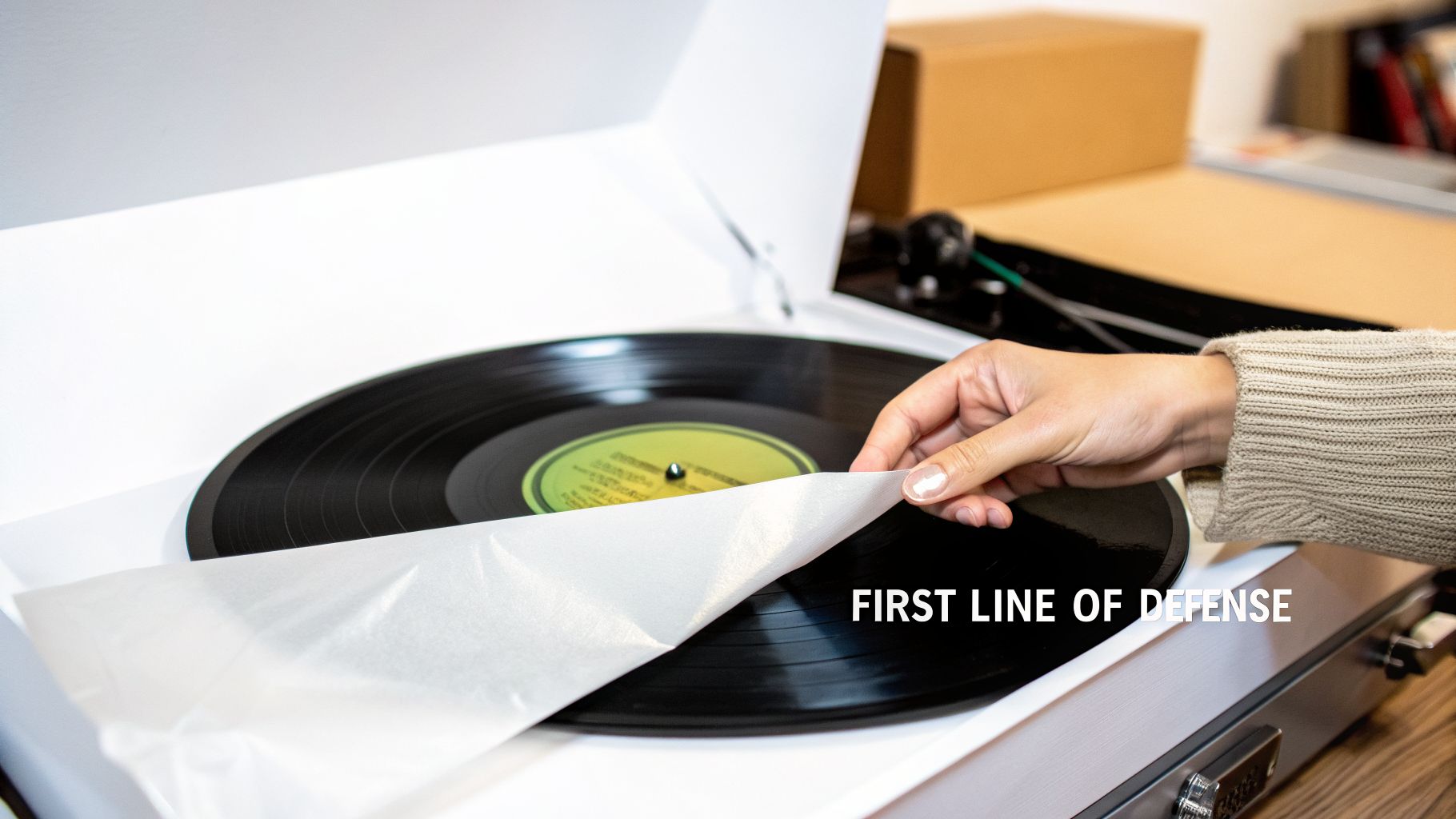
Your record collection is more than just music; it’s a physical investment in art and history. You wouldn’t store a priceless painting against rough cardboard, and your LPs deserve the same respect. A quality inner sleeve provides that essential protective layer between the delicate vinyl surface and the outer jacket.
The generic paper sleeves that come with most records—new or old—are often the biggest threat. They constantly shed paper fibres that clog the grooves, and their coarse texture grinds against the vinyl every time you slide it in or out. These tiny abrasions build up, creating pops, clicks, and surface noise that permanently ruin the listening experience.
The Enemies of Pristine Vinyl
A proper inner sleeve is engineered to fight the three main enemies of your LPs:
- Static: Cheap sleeves generate static electricity, turning your record into a magnet for dust. Good anti-static sleeves stop this charge from ever building up.
- Scuffs and Scratches: A soft, non-abrasive material, like polyethylene, glides smoothly over the vinyl. This prevents the hairline scratches that cheap paper sleeves inflict.
- Dust and Debris: The sleeve acts as a physical barrier. It keeps airborne particles from settling into the grooves where your stylus can grind them in forever.
It’s easy to overlook common issues that stem directly from poor inner sleeves. This quick guide breaks down the problems and their solutions.
Quick Guide to Common Inner Sleeve Problems
| Problem | Common Cause | Recommended Sleeve Solution |
|---|---|---|
| Pops, Clicks, and Hiss | Dust and paper fibres trapped in grooves. | Anti-static polyethylene sleeves to prevent dust attraction. |
| Visible Hairline Scratches | Rough paper or cardboard sleeves abrading the surface. | Archival-grade, non-abrasive sleeves (e.g., MoFi). |
| Persistent Dust on Record | Static charge from low-quality plastic or paper sleeves. | Sleeves with a dedicated anti-static treatment. |
| Chemical Haze or “Off-Gassing” | PVC sleeves reacting with the vinyl over time. | Chemically inert materials like polyethylene or polypropylene. |
Upgrading your sleeves is the single best investment you can make for the long-term health of your collection.
An archival-safe inner sleeve isn’t a minor accessory; it is the fundamental starting point for serious vinyl care. It’s the single most effective action you can take to ensure your records sound pristine for decades.
Upgrading your inner sleeves is just as important as keeping your records clean. A great sleeve prevents new debris from getting on the record, but you still need to deal with any dust that’s already there. To learn more, check out our guide on choosing the right brush for cleaning vinyl records. By pairing quality sleeves with regular cleaning, you create a complete system for long-term preservation.
To truly get why today’s sophisticated inner sleeves for LPs exist, you have to wind the clock back to the UK music scene of the 1950s and 60s. The modern vinyl sleeve wasn’t some sudden invention. Instead, it was slowly perfected out of necessity by British record shops, creating a blueprint for how we protect our records today.
Before this time, protection was an afterthought. A major label like EMI, for instance, just used simple polythene bags for its records before September 1956. The move to a paper sleeve with a thin polythene lining was a huge leap forward, offering both structure and a surface that wouldn’t scuff the grooves. You can see some great examples of these early EMI sleeves on aroundandaroundcom.wordpress.com and get a real feel for this transition. That simple upgrade was the beginning of everything we now consider essential for archival safety.
A Uniquely British Retail System
What really cemented the inner sleeve’s importance in Britain was how records were actually sold. Forget the open racks we browse today. Back in the mid-20th century, most UK shops only put the empty outer jackets on display for customers to flip through. It was a clever way to stop theft and prevent grubby fingerprints from ruining the precious vinyl.
The LPs themselves, each nestled in its inner sleeve, were kept safely behind the counter. When you picked an album, the shop assistant would fetch the right record and pair it with its jacket right before you paid. This turned the inner sleeve from a basic dust cover into a vital piece of the entire retail puzzle.
From Shop Counter to Collector’s Shelf
This behind-the-counter system had a lasting effect. Shop staff needed to find the right record for a specific jacket quickly, so they often scribbled catalogue numbers or other notes directly onto the inner sleeve. It was a primitive but effective form of inventory management, creating a permanent link between that specific sleeve and the pressing inside.
This unique UK retail model reinforced the dual role of the inner sleeve: it was simultaneously a protective shield for the vinyl and a key organisational tool for the shop.
This bit of history proves the humble inner sleeve was never just a throwaway wrapper. It was born from the practical need to protect music in a busy shop, making it a core part of the vinyl experience from day one. The anti-static, archival-grade inner sleeves for LPs that we rely on as audiophiles and DJs are the direct descendants of those workhorse originals, carrying on a very British tradition of looking after the music we love.
Choosing Your Armour: A Showdown of Sleeve Materials
Picking the right material for your inner sleeves for LPs is the single most important call you can make to protect your collection. Think of it like this: you wouldn’t head out into a downpour wearing a wool jumper. In the same way, the material of an inner sleeve determines how well it guards your records against static, dust, and scuffs.
What you choose has a real, direct impact on the life and sound of your vinyl. It’s not about finding one perfect sleeve for everything. It’s about matching the right level of protection to the value and how often you play each record.
This chart shows the classic hierarchy of protection that evolved here in the UK, moving from basic shop bags to more deliberate, organised systems.
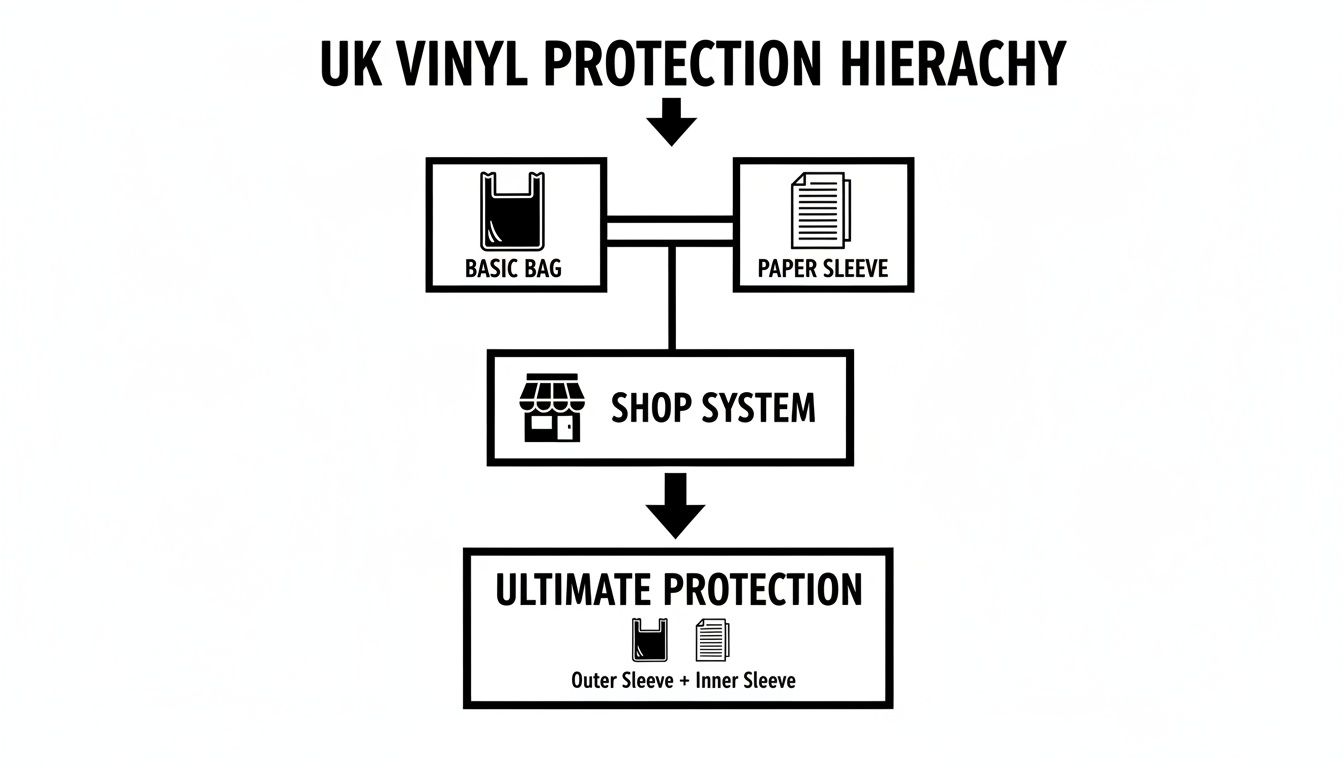
As you can see, structured paper sleeves became the core of a real protection strategy, moving us beyond simple dust covers. Let’s break down the main materials on the market today so you can make a properly informed choice.
The Basic Paper Sleeve
This is the sleeve that comes with most records, both new and second-hand. And while it’s better than absolutely nothing, a plain paper sleeve is the enemy of a clean record. They’re coarse, they shed fibres that get stuck in the grooves, and they create a ton of static.
Just imagine lightly rubbing sandpaper on a delicate surface. That’s what a cheap paper sleeve does to your record on a microscopic level, every single time you pull it out. If you care about a record, replacing these should be your top priority.
The Poly-Lined Paper Sleeve
Now we’re talking. A big step up, the poly-lined paper sleeve gives you a brilliant balance of cost and protection. It’s a standard paper sleeve on the outside, but it has a thin, fixed layer of polyethylene plastic on the inside.
This design really does give you the best of both worlds:
- Structure: The paper gives it enough stiffness to slide easily back into the record jacket without bunching up.
- Safety: The smooth poly lining doesn’t scratch the vinyl and dramatically cuts down on static, which stops dust from clinging to the surface.
This hybrid is a fantastic, affordable upgrade for the bulk of your collection. It’s a no-brainer.
High-Density Polyethylene (HDPE) Sleeves
Often called ‘rice paper’ or ‘archival’ sleeves, these are the gold standard. HDPE sleeves are made from a soft, almost silky translucent plastic that’s naturally anti-static and chemically stable.
HDPE sleeves are like silk for your records. They create virtually zero friction, so there’s no risk of micro-scratches, and their anti-static nature actively repels dust. Your vinyl simply stays cleaner for longer.
They are the priciest option, no doubt. But for your first pressings, limited editions, or any records you DJ with regularly, investing in HDPE inner sleeves for LPs is money well spent. Their durability and top-tier protection ensure your most treasured albums stay in mint condition.
To help you see the differences at a glance, here’s a simple breakdown of the main contenders. This should make it easier to decide what’s right for your collection and your budget.
Inner Sleeve Material Comparison
| Material Type | Pros | Cons | Best For |
|---|---|---|---|
| Plain Paper | Very cheap, provides basic dust cover. | Abrasive, sheds fibres, high static. | Temporary storage, records you don’t care about. |
| Poly-Lined Paper | Good protection, non-abrasive, low static, rigid and easy to handle. | More expensive than plain paper, liner can sometimes separate on very old sleeves. | The bulk of any collection; a great all-round upgrade. |
| HDPE (Archival) | Excellent archival protection, non-abrasive, anti-static, chemically inert. | Most expensive option, can be flimsy and bunch up. | Valuable pressings, rare records, and frequently played albums. |
Ultimately, choosing the right sleeve is about matching the material to the record’s value and how you use it. A mix-and-match approach—using poly-lined for most of your collection and upgrading to HDPE for your prized albums—is often the most practical and cost-effective strategy. Getting familiar with various materials for packing can also give you a broader sense of what makes certain plastics safer for long-term storage.
When Inner Sleeves Tell a Story
We usually think of inner sleeves for LPs as simple protection against dust and scratches. But some sleeves are so much more. During vinyl’s golden age, record labels realised the inner was prime real estate—a blank canvas for art, advertising, and identity.
These printed inners transformed from mere packaging into historical artefacts. Finding a vintage record with its original, label-specific inner sleeve is like discovering a hidden chapter. It’s a direct link to an album’s first release, and for collectors, the right inner can dramatically boost a record’s provenance and value.
The Blue Note Blueprint
No label understood the power of the printed inner sleeve quite like Blue Note Records. They weren’t just protecting records; they were building an entire musical world for their listeners.
Between 1961 and 1966, Blue Note pioneered a brilliant marketing strategy, using their inner sleeves to advertise the rest of their catalogue. They showcased an incredible 72 current releases, cramming 36 miniature album covers onto each side. Over those years, they created nine different sleeve designs, each tied to specific pressings. You can explore the incredible detail of these iconic Blue Note inner sleeves on londonjazzcollector.wordpress.com to see their evolution.
For serious collectors, a Blue Note LP isn’t truly ‘complete’ without its period-correct inner sleeve. It’s the final piece of the puzzle that verifies an original pressing.
The Vertigo Swirl and Beyond
This trend wasn’t just limited to jazz. Over in the UK, the inner sleeve became a powerful symbol of the psychedelic and progressive rock era of the late 60s and early 70s.
Labels like Vertigo Records created the legendary ‘Swirl’ inner, an iconic design that’s instantly recognisable to any fan of the period. Just seeing that hypnotic pattern tells you you’re holding a piece of music history. Island Records had their custom pink or black inners, and Harvest Records developed their own distinct designs.
These sleeves weren’t just packaging; they were a badge of identity. If you’re keen to hunt down some of these treasures yourself, our guide on where to buy vinyl records in London is the perfect place to start your search.
A Practical Guide to Sleeving and Storing Your Records
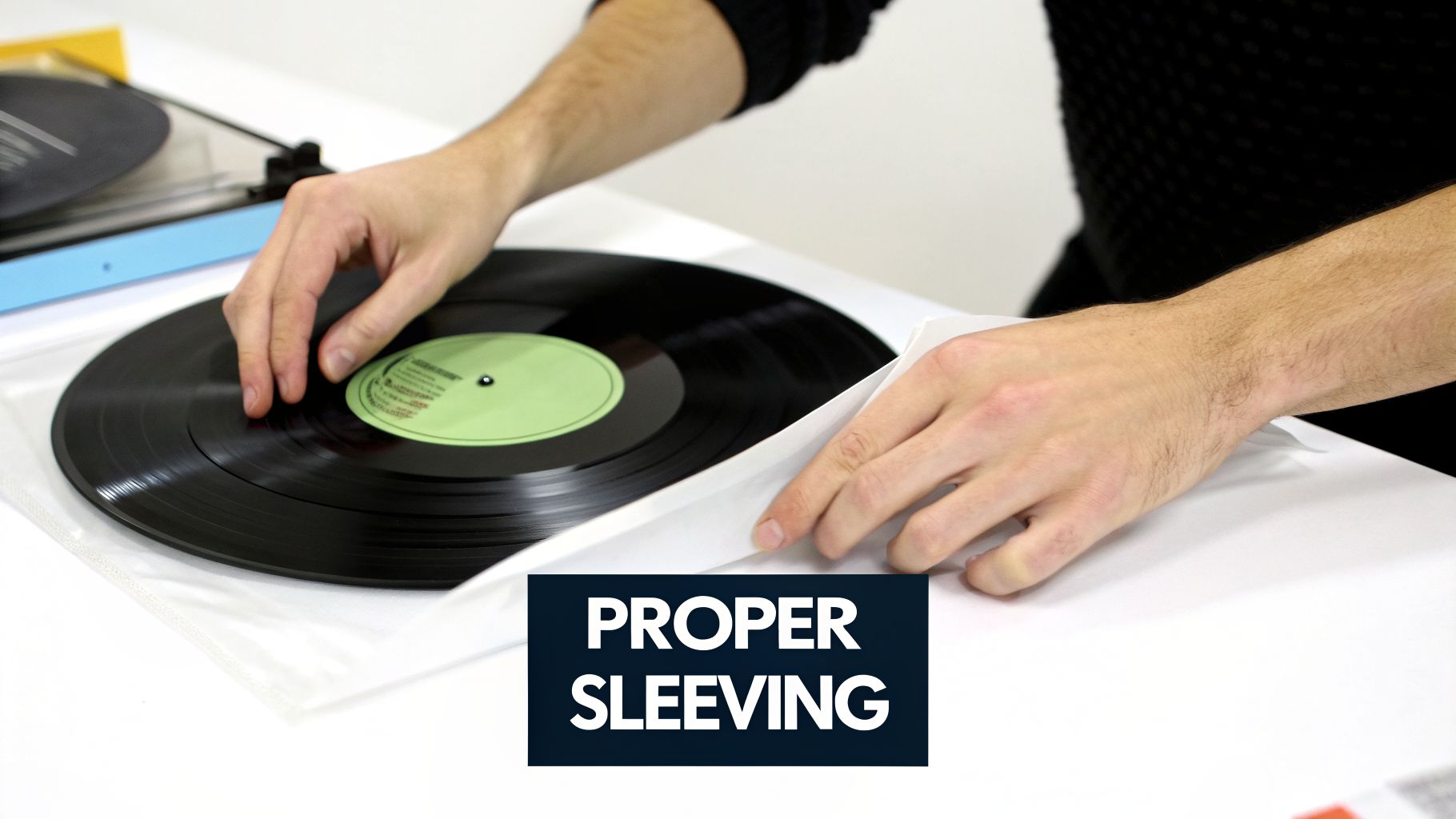
Owning the right inner sleeves for LPs is one thing, but knowing how to use them is where the real preservation work begins. Get the technique right, and your records will stay pristine from the moment you re-sleeve them to their spot on the shelf. It’s all about developing a confident, gentle touch.
First, you’ll likely need to rescue a record from its original, scratchy paper sleeve. Always handle your vinyl by its edges and the centre label. This keeps the natural oils from your fingers out of those delicate grooves. The goal is to let the record slide out of the old sleeve and into the new one without any force at all.
How to Sleeve Your Records
The trick here is to minimise physical contact and stop static from building up. A light hand is everything.
- Prepare the New Sleeve: Get your new anti-static sleeve open and ready. If you’re using a poly-lined or ‘rice paper’ sleeve, a gentle puff of air into the opening can help separate the layers.
- Remove the Record: Tilt the old jacket and sleeve just enough for the record to start sliding out on its own. Catch it carefully by its edges.
- Insert into New Sleeve: Without putting the record down, guide it smoothly into the new archival sleeve. The soft material is designed to let it glide in with almost no friction.
Once you’ve done it a few times, this simple process becomes second nature. It’s a fundamental part of proper, long-term vinyl care.
The most critical decision after sleeving is which way it faces inside the jacket. Storing the inner sleeve with its opening facing upwards creates a surprisingly effective dust seal, stopping airborne particles from ever reaching your vinyl.
Storing Your Sleeved LPs
That tiny detail—the orientation of the opening—has a massive impact. Sure, placing the opening sideways makes for quicker access, but it also leaves a direct path for dust to creep in. For long-term protection, always face the opening up. This is a core archival practice for a reason.
Of course, proper storage goes well beyond just the inner sleeve. To get the full picture on essential preservation techniques, you can explore our detailed guide on how to store vinyl records properly. Combine careful handling with the right storage methods, and your collection will stay in brilliant, playable condition for years to come.
Got Questions About Inner Sleeves?
Even the most dedicated collectors have questions about the finer points of inner sleeves for LPs. We hear them all the time. Here are some straight answers to help you protect your collection with confidence.
Whether you’re just starting out or have been spinning records for decades, getting this right is crucial.
Should I Ditch the Original Printed Inner Sleeves?
This is a great question, and the answer is a firm no. If an album comes with an original inner sleeve—especially one with lyrics, photos, or classic label art like the Vertigo ‘Swirl’—you absolutely keep it. These are part of the original package and are essential to a record’s value and history.
However, you shouldn’t use them for day-to-day protection. The best practice is to move the vinyl itself into a fresh, archival-quality anti-static sleeve. Then, you can slide both the newly sleeved record and the original printed inner back into the album jacket together. You get modern protection without sacrificing any of that original magic.
What’s the Difference Between Polyethylene and Polypropylene?
Both are top-notch, chemically stable plastics perfect for archival use, but they have very different jobs.
- High-Density Polyethylene (HDPE): This is the incredibly soft, cloudy-looking material you find in premium ‘rice paper’ style inner sleeves for LPs. Its biggest advantage is that it’s naturally anti-static and incredibly gentle, creating almost zero friction against your vinyl.
- Polypropylene: This plastic is much clearer, shinier, and more rigid. That crystal clarity makes it the only real choice for outer sleeves, as it shows off your album art without any distortion. It’s not ideal for inners because it’s more likely to build up static compared to HDPE.
Think of it this way: HDPE is the soft, protective liner for the record itself, while polypropylene is the crisp, clear display case for the jacket.
A high-quality archival inner sleeve, like one made from HDPE, is built to last for decades. Under normal home conditions, you should only need to replace one if it gets physically torn, dirty, or contaminated in some way.
How Often Should I Replace My Inner Sleeves?
Unlike those cheap paper sleeves that shed fibres and degrade over time, a quality poly-lined or HDPE sleeve is a long-term move. They don’t break down or release any nasty chemicals.
For most collectors, this means buying good sleeves is a one-and-done deal for each record you own.
Should the Inner Sleeve Opening Face Up or Sideways?
For the best possible protection against dust, the proven archival method is to place the inner sleeve inside the jacket with its opening facing up.
This simple step creates a surprisingly effective barrier, stopping dust and other airborne particles from settling down onto your record’s grooves over time. While facing it sideways gives you faster access, the upward-facing method offers far better long-term protection.
At VinylGold, we know that proper care is the foundation of a great collection. Give your records the protection they deserve.